

Reader's Theater Worksheets
Kansas State History Grade 7 | Reader's Theater Script & Mini Readers Bundle
Kansas State History Grade 7 | Reader's Theater Script & Mini Readers Bundle
Couldn't load pickup availability
Classroom Use at a Glance
Ten Grade 7 Kansas State History Reader’s Theater scripts with 100 scenes; twenty differentiated Mini Readers, lesson teacher guides, source-based written questions, vocabulary and self-grading quizzes. Topics span Kaw community life, territorial politics, civil rights, agriculture and reform.
Subjects History, Social Studies, ELA, Geography view all
- History
- Social Studies
- ELA
- Geography
Classroom Uses Sub Plan, Small Groups, Whole Class, Fluency Practice, Close Reading, Discussion, Assessment, Review, Performance Reading, Content-Area Reading view all
- Sub Plan
- Small Groups
- Whole Class
- Fluency Practice
- Close Reading
- Discussion
- Assessment
- Review
- Performance Reading
- Content-Area Reading
Included Reader’s Theater Script, Original Mini Reader, Accessible Mini Reader, Teacher Guide, Student Worksheet, Answer Key, Quiz, Google Forms Quiz, Vocabulary, Discussion Questions, Challenge Questions, Slides view all
- Reader’s Theater Script
- Original Mini Reader
- Accessible Mini Reader
- Teacher Guide
- Student Worksheet
- Answer Key
- Quiz
- Google Forms Quiz
- Vocabulary
- Discussion Questions
- Challenge Questions
- Slides
Format DOCX, Google Docs, Google Slides, Google Forms, ZIP Download, Printable, Editable view all
- DOCX
- Google Docs
- Google Slides
- Google Forms
- ZIP Download
- Printable
- Editable
Differentiation Leveled Version, Accessible Version, Original Version, Mixed Reading Levels, Vocabulary Support, Small-Group Support view all
- Leveled Version
- Accessible Version
- Original Version
- Mixed Reading Levels
- Vocabulary Support
- Small-Group Support
Ten connected Kansas history investigations, ten different dramatic problems. A seasonal decision at a Kaw village opens the story. Next come the Santa Fe Trail, contested territorial elections, difficult constitutional choices, the First Kansas Colored Infantry, cattle drives, Black homesteading, women’s voting rights, the Dust Bowl and the fight to desegregate Topeka schools. This complete Grade 7 teaching bundle moves chronologically without asking students to memorize an unwieldy cast of historical events in one script.
The ten lessons work separately or as a Kansas History sequence. Each centers on one historical dilemma, supported by source notes and differentiated reading. Students perform the story, revisit the historical facts in two Mini Readers, and support their conclusions with evidence rather than treating fictional dialogue as a primary source.
Try the format at no cost. Where the Rivers Meet — Part 1 (FREE) is the same complete ten-scene, Grade 7 lesson format as the other nine products. It is included in this bundle alongside Parts 2–10.
The Story Students Perform
Each ten-scene drama develops a different, manageable conflict. A Kaw grower challenges a premature departure plan; a Council Grove caravan encounters the question of land rights; a territorial newspaper grapples with contested election claims; a statehood editor learns that drafting a constitution does not settle citizenship; Black volunteers confront restrictions on military service. Later lessons examine cattle-disease concerns in Abilene, an immigrant family’s expectations at Nicodemus, a difficult women’s-suffrage campaign, soil-conservation choices during the Dust Bowl, and the parents and organizers who challenged segregated education in Topeka. The dialogue is invented for teaching; key events, sources and historical consequences are documented in the guides.
Historical Learning Focus
- Identify Kaw/Kanza community practices and distinguish Indigenous homelands from the later history of U.S. expansion.
- Connect commerce, migration and government to the complicated choices of Kansans from the 1820s through statehood.
- Analyze how claims about political participation and equal rights changed during territorial conflict, wartime, reform and civil-rights litigation.
- Explain Kansas railroad cattle markets, Black homesteading, and the relationships among geography, land use and agricultural livelihoods.
- Interpret the relationship between drought, human land-use decisions and conservation responses.
- Practice historical source comparison, evidence-based claims, perspective taking and cause-and-effect explanations.
At a Glance
- Grade: Grade 7 Kansas History, with a Grades 6–8 writing and reading profile.
- Lessons: 10 complete Reader’s Theater units, 10 scenes each — 100 scenes across the bundle.
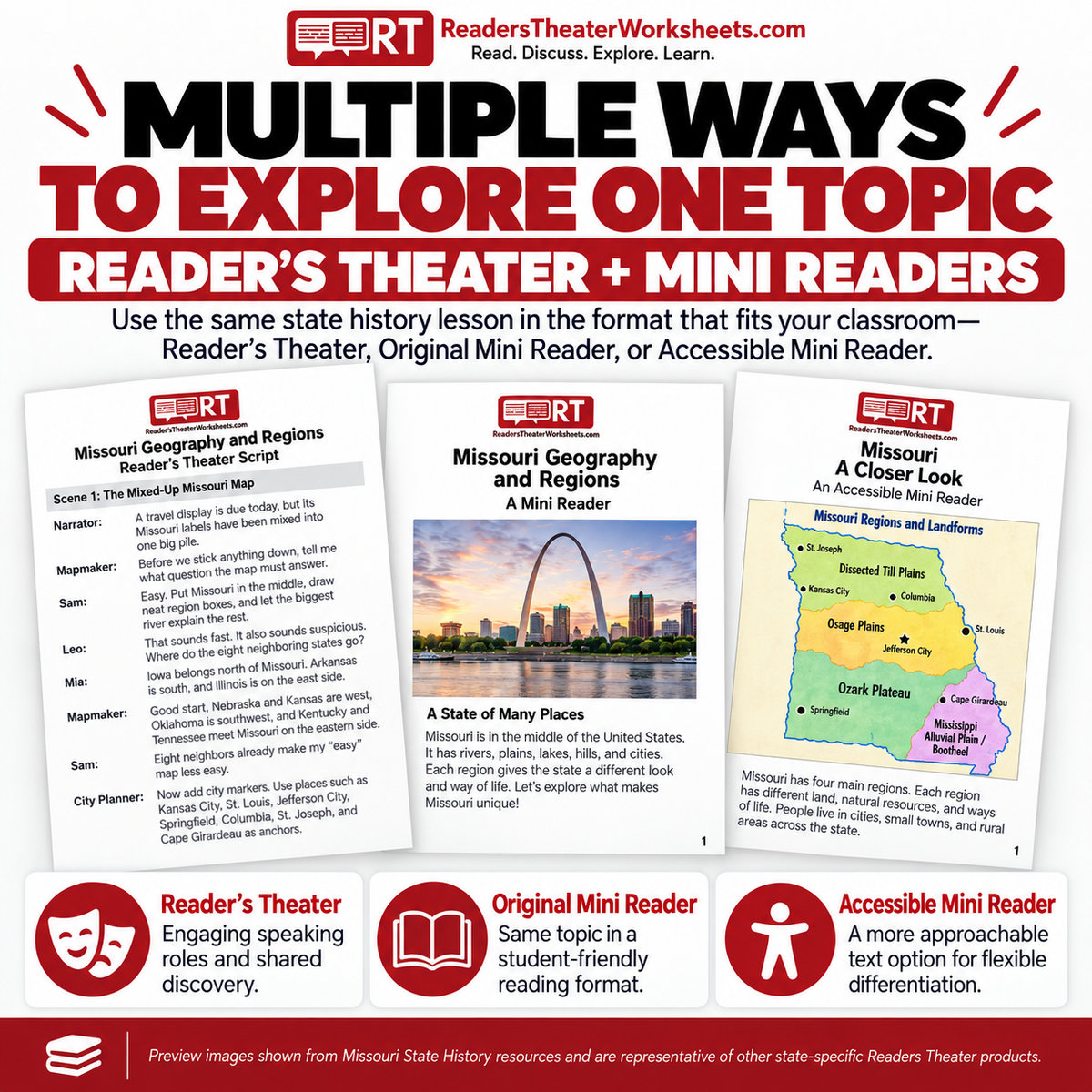
- Readers: 20 Mini Readers total, with an Original and Accessible version for each lesson.
- Assessment sets: Each lesson has 10 two-part short-answer questions, 5 two-part challenge questions, and a 20-item multiple-choice quiz. Across the bundle: 100 short-answer, 50 challenge and 200 multiple-choice questions.
- Planning: Individual Teacher Guides provide options for one, two or three class periods.
- Access: Each lesson uses its Start Here PDF to explain the shared classroom resources and editable copies.
What’s Included
- Ten ten-scene Reader’s Theater scripts with casting information.
- Twenty differentiated nonfiction Mini Readers (ten Original and ten Accessible).
- Ten Teacher Guides with pacing options, historical context, vocabulary, standards and source references.
- One vocabulary set and written-response questions with answer keys per lesson.
- Twenty-question multiple-choice assessments, aligned teacher keys, and answer-free print versions for every lesson.
- Digital teaching resources in the linked lesson folders, including Google Slides and self-grading Google Forms materials.
- Ten Start Here PDF access guides with lesson-specific shared-folder links.
Teaching and Differentiation
Read the historical problem aloud or assign performance roles; pause when characters disagree over evidence or consequences. Let readers choose the Original or Accessible Mini Reader while discussing the same core facts. Teachers can select a shorter inquiry with the exit quiz or extend the lesson with written answers and a source comparison. The Grade 7 language remains age-appropriate without making the Accessible version sound elementary.
Several lessons have an approved illustrated Kansas regions-and-rivers support map. Its river paths are explicitly labeled as approximate instructional reference, not exact geographic tracing. Not every lesson uses a map, and the resource does not require classroom prop arrangements or complicated staging.
Skills and Classroom Uses
- Oral fluency, historical reading comprehension and vocabulary in context.
- Text evidence, historical cause and consequence, perspective comparison and evidence-based argument.
- Whole-class discussions, independent reading, mixed-level groups, substitute plans, review and performance reading.
Standards and Historical Accuracy
Designed for the middle-level Kansas History course aligned to Kansas History, Government, and Social Studies standards, with a Grade 7 focus and Grades 6–8 writing profile. Each Teacher Guide identifies its own standards benchmarks and sources; the bundle does not claim exhaustive treatment of every Kansas History topic. Historical characters’ direct quotations are not fabricated as primary-source testimony.
All 10 Kansas State History Lessons
Every title below opens the existing individual product listing; the series is ordered chronologically. Part 1 is the free introductory lesson, not an eleventh product.
- Part 1 — Where the Rivers Meet: Kaw village life, corn cultivation, seasonal bison hunts and the Kansas River valley.
- Part 2 — A Road Through Someone Else’s Land: Santa Fe Trail commerce at Council Grove, Indigenous land rights and treaty negotiations.
- Part 3 — Who Gets to Decide Kansas?: Bleeding Kansas, contested territorial elections, intimidation and popular sovereignty.
- Part 4 — Four Constitutions, One State: four constitutional attempts, political rights and the road to Kansas statehood.
- Part 5 — Will They Let Us Fight?: Black volunteers in the First Kansas Colored Infantry and the fight for recognition.
- Part 6 — The Cattle Can’t Stay Here!: Abilene’s railroad cattle market, farmers’ concerns and cattle disease risks.
- Part 7 — The Promise of Nicodemus: the founding of Nicodemus, Black homesteading and the realities of life on the plains.
- Part 8 — A Vote on Who May Vote: Kansas women’s suffrage organizing and the statewide 1912 voting-rights amendment.
- Part 9 — When the Wheatfield Turned to Dust: western Kansas farms, drought, soil erosion and the Dust Bowl.
- Part 10 — The School They Could Not Enter: Topeka families’ school desegregation case and the Brown v. Board of Education decisions.
How Digital Access Works
After acquiring the bundle, use each lesson’s Start Here PDF and its red shared-folder button to open the corresponding Google Drive classroom materials. Make your own editable copies before assigning work; keep the teacher answer keys separate from student copies. The folder instructions also explain what to do when school-domain permissions restrict access.
Start with the complete free lesson: Where the Rivers Meet (Part 1). You can also review any of the nine remaining lesson listings above before teaching the full set.
Share