Readers Theater Worksheets
Oklahoma State History Complete Bundle | 10 Reader’s Theater Lessons + Mini Readers | Grade 3
Oklahoma State History Complete Bundle | 10 Reader’s Theater Lessons + Mini Readers | Grade 3
Couldn't load pickup availability
Classroom Use at a Glance
Complete Oklahoma Grade 3 State History bundle: 10 lessons, 100 Reader’s Theater scenes, 20 differentiated Mini Readers, vocabulary, written assessments, quizzes and Teacher Guides, from Oklahoma rivers and Spiro through Greenwood, statehood and the Dust Bowl.
Subjects History, Social Studies, Geography, ELA view all
- History
- Social Studies
- Geography
- ELA
Classroom Uses Sub Plan, Small Groups, Whole Class, Fluency Practice, Close Reading, Discussion, Assessment, Review, Performance Reading, Content-Area Reading view all
- Sub Plan
- Small Groups
- Whole Class
- Fluency Practice
- Close Reading
- Discussion
- Assessment
- Review
- Performance Reading
- Content-Area Reading
Included Reader’s Theater Script, Original Mini Reader, Accessible Mini Reader, Teacher Guide, Student Worksheet, Answer Key, Quiz, Google Forms Quiz, Vocabulary, Discussion Questions, Challenge Questions, Writing Prompt view all
- Reader’s Theater Script
- Original Mini Reader
- Accessible Mini Reader
- Teacher Guide
- Student Worksheet
- Answer Key
- Quiz
- Google Forms Quiz
- Vocabulary
- Discussion Questions
- Challenge Questions
- Writing Prompt
Format PDF, DOCX, Google Docs, Google Slides, Google Forms, Printable, Editable view all
- DOCX
- Google Docs
- Google Slides
- Google Forms
- Printable
- Editable
Differentiation Leveled Version, Accessible Version, Original Version, Mixed Reading Levels, Vocabulary Support, Small-Group Support view all
- Leveled Version
- Accessible Version
- Original Version
- Mixed Reading Levels
- Vocabulary Support
- Small-Group Support
Ten Oklahoma stories. One complete Grade 3 history journey. What do a road-trip map, an ancient trade center, a territorial newsroom and a Tulsa neighborhood reveal about the state? This Oklahoma Studies bundle invites students to find out through dialogue, evidence, maps, historical questions and carefully differentiated reading.
Rather than relying on a single survey story, this sequence follows Oklahoma’s places and people across time: Native societies and living sovereignty, movement and settlement, cattle markets, Black communities and Greenwood, statehood, the Dust Bowl, and a diverse modern economy. Each lesson stands alone while its big questions connect to the ten-part series.
What Makes the Bundle Useful
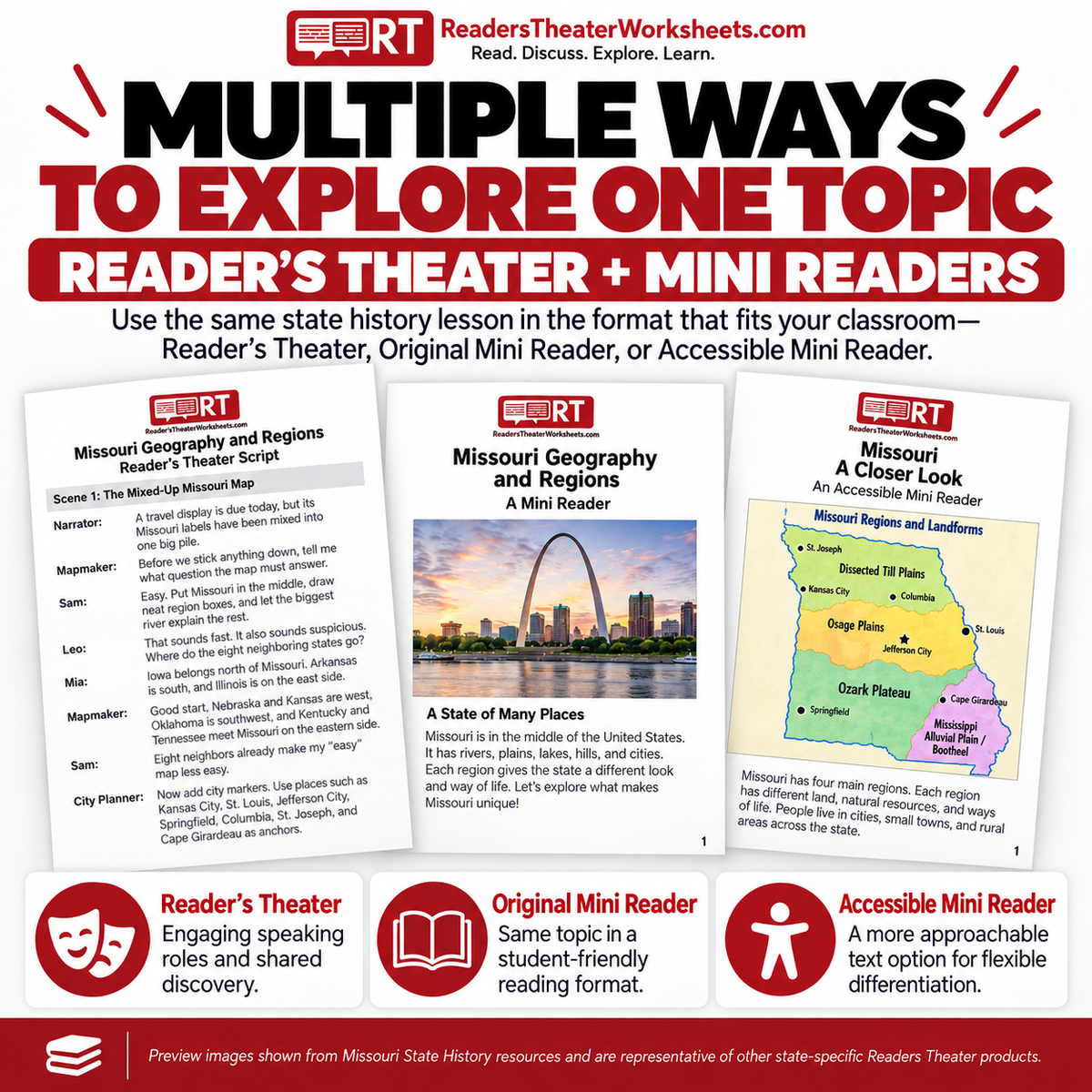
Each of the ten lessons features a ten-scene Reader’s Theater with named speaking roles, an Original Mini Reader, a genuinely differentiated Accessible Mini Reader, teaching guidance and standards connections. The two Mini Readers teach the same important historical evidence at different reading demands, so mixed-reading-level groups can discuss common questions.
Students do more than repeat dates: they compare descriptions with geographic evidence, examine what historical records can and cannot establish, ask whose perspective is missing, and connect the environment with human decisions. The teacher-facing material provides lesson pacing, casting and answer guidance suitable for whole-class performance, centers, fluency practice and content-area reading.
Ten Lessons Included, in Sequence
- P01 — The Oklahoma Road Trip: One State, Many Landscapes — A class road trip challenges the claim that Oklahoma is only flat and dry. Students compare the High Plains, Red Bed Plains, mountain areas, major rivers and the wooded east.
- P02 — Spiro and the First Nations — Student exhibit curators explore Spiro Mounds, Arkansas River connections, agricultural life, artifacts and the difference between supported trade evidence and guessed routes.
- P03 — Expeditions and Early Encounters — A classroom podcast tests accounts connected with Coronado, Washington Irving and George Catlin against maps, evidence and differing travel perspectives.
- P04 — Removal, Resilience and Sovereignty — Editors revise misleading accounts of forced removal and Indian Territory, recognizing the separate histories, enduring identity and modern sovereignty of Tribal Nations.
- P05 — Cattle Trails and Crossroads — A cattle-drive story follows work, water, vaquero influence, trail choices and railroad markets while examining people and places across Indian Territory.
- P06 — The Land Openings — Characters examine the 1889 opening, town development and disputed claims, distinguishing the experience of newcomers from Native dispossession and continuing sovereignty.
- P07 — Black Towns and Greenwood — A community-history display examines Oklahoma all-Black towns and Greenwood enterprise, the 1921 Tulsa Race Massacre and the community’s rebuilding.
- P08 — Making Oklahoma a State — A territorial newsroom checks the evidence for statehood, comparing Indian Territory and Oklahoma Territory, the Sequoyah proposal and the 1907 statehood transition.
- P09 — Living Through the Dust Bowl — Museum investigators test a dramatic Dust Bowl exhibit claim against evidence of drought, exposed soils, storms, family responses and conservation in the Panhandle.
- P10 — Oklahoma’s Industries and Innovators — Students challenge an oil-only view of Oklahoma’s economy by examining farming, petroleum, transportation, cultural contributions and innovation.
Free first lesson: P01 — The Oklahoma Road Trip: One State, Many Landscapes is available separately at no charge, so teachers can preview the writing style and differentiation before using the entire series.
Teaching Materials Across the Ten Lessons
- 10 Reader’s Theater scripts — a total of 100 scenes with casting information and student-centered dialogue.
- 20 Mini Readers — ten Original versions and ten Accessible versions covering each lesson’s central evidence.
- Teacher Guides — pacing suggestions, learning objectives, standards alignment, historical context, supporting sources and answer keys.
- Vocabulary and reading work — 10 vocabulary terms per lesson, short-answer and challenge questions with teacher guidance.
- Quizzes — 20 multiple-choice questions per lesson with print and teacher versions, plus Google Forms delivery where supplied by the factory output.
- Geographic support — selected lessons contain a simplified Oklahoma regions-and-rivers map; the map is an instructional illustration, not a precise historical route survey.
Curriculum Connections and Historical Care
Built for Oklahoma Grade 3 Oklahoma Studies, with emphasis on reading physical and political maps; rivers, regions and resources; understanding early peoples, Tribal governments and sovereignty; tracing state development and migration; discussing economic activities; and using textual evidence to compare accounts. Specific standard identifiers and source notes appear in individual Teacher Guides.
Indigenous communities are represented as distinct Nations with living governments, rather than as a vanished past. Lessons on the land openings, Greenwood and the Tulsa Race Massacre address difficult history through age-appropriate questions supported by evidence. The stories use dramatized classroom or historical frames; invented dialogue is not presented as a primary-source quotation.
Ideas for Using the Complete Sequence
- Teach one lesson per unit or follow the P01–P10 progression through Oklahoma Studies.
- Give mixed-ability groups different Mini Reader versions while they examine the same important questions.
- Use the ten-scene scripts for reading fluency, group roles, speaking and listening, or end-of-unit performances.
- Check understanding with vocabulary, written assessments, class discussion and self-grading quizzes.
- Use the short historical research/source notes to build a teacher-led evidence-checking routine.
How Digital Access Works
- Open the included lesson resources. Each lesson has a matching START HERE PDF with its own Google Drive shared-folder link.
- Use the PDF button to open that lesson’s source folder, then make classroom copies of editable documents, slides or forms before adapting or assigning them.
- Follow the PDF troubleshooting guidance if your school Google account blocks access to a shared folder.
Digital product: No physical materials ship. This listing describes the complete ten-lesson teaching series; individual lesson links above allow you to review the full lesson descriptions. The seller should include the promised ten lesson access files with the bundle’s actual digital delivery before publishing.
Share